


Teaching, trauma and facing fears
- Ian Cheney
- Feb 26
- 6 min read
Updated: Mar 3
How we face our fears every day, and how our yoga practice can be the perfect training ground.
Triggers
Over the Christmas period, I had the privilege of attending a teachers course in London. There was a ‘Vegas rules’ agreement for all those who took part (‘what happens in Vegas, stays in Vegas’). Therefore I shall divulge only that one of the sessions took us through a trauma informed approach to teaching yoga. This was a really useful framework to help consider all students' wellbeing. I’m sure anyone who has taught for even a little while, will have encountered a difficult situation with a student, where such insight could be useful.
I have discussed in previous blogs how many in the yoga world, often question whether yoga (and Ashtanga specifically) is a hotspot for “troubled souls”. Or whether at least that it attracts more than other activities do. Generally speaking, I have always thought that a Shala is merely a reflection of the world at large. However, I do understand that rightly or wrongly, yoga is broadly perceived to offer some sort of healing and therefore, may naturally attract a higher proportion of people seeking just that.
Anyway, one key element of the framework was regarding ‘triggers’. How to be aware of what could trigger a student and to be cautious not to.
What are we actually doing?
This in turn triggered something in me. A connection to a topic I’d been processing for some time. I mean, what are we actually doing when teaching? (I have also discussed this topic at length in a previous blog.)
Some of what we do, showing new poses, correcting poses, adjusting students, is obviously 'teaching'. But often, as a Mysore teacher at least, it feels like teaching is also a process of deliberately trying to press students' buttons. Perhaps part of the job therefore is in fact, to try and trigger them?
Before I continue, let me clarify now that I don’t mean I am going out of my way to upset anyone or cause harm. What I am getting at is that teaching to me is frequently about helping students face their fears.
To be clear, trauma is not the same thing as fear, or even extreme fear. But within the context of both this workshop and the yoga world at large, it was (and is) often used synonymously.
As a Mysore teacher, we deal with students’ fears every day. This can be in obvious poses - inversions and deep back bands typically. Just think: drop backs, Kapotasana (dove pose), Pincha Mayarasana (peacock feather pose), Sirsasana (headstand) etc. But you also find that for some students, even a basic bind can be scary if they have never put their body into that shape before. Personally I have found, that the students who tend to have the most difficulty with Supta Kurmasana (sleeping tortoise pose) are generally not those who have a physical restriction with the posture, but the ones who are just utterly terrified by it.
Now as teachers, for the benefit of the student, we can avoid such situations . We can find work arounds to avoid causing fear. We can simply back off. Often, that is exactly the right thing to do, to give the student whatever time and space they need.
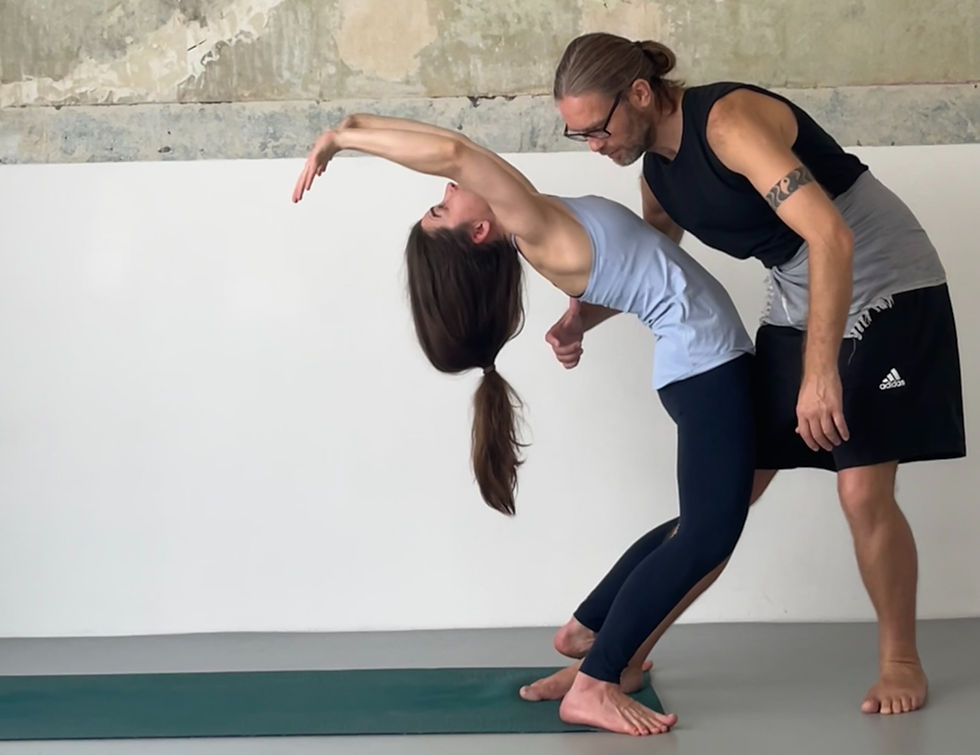
But ultimately, if the student wants to learn to do something they are afraid of, then they will need to face that fear. And as a teacher therefore, our role might in fact be, to encourage the student to stand on the edge of the cliff by themselves.
Perhaps at first, this requires our full support, to stand by their side, perhaps a few steps back from the edge. Then gradually we help them step closer, until they are able to stand there and look out across the horizon alone.
Fury
Some of you will know already, that I’m a bit of a Salman Rushdie fan. The first book of his I read - Fury - was eagerly consumed while backpacking in my 20s. (To be specific, it was while taking a slow boat down the Mekong to Luang Prabang in Laos. Trust me however, the reality of this experience was a lot less romantic than it might sound……).
Released in 2001, the book is set in pre 9/11 New York and somewhat prophetic in its diagnosis of America's ills before the Twin Towers came down, the war on terror and everything else that ensued.
There was one specific quote from this book that always stuck with me:
‘He had to go through it all over again: the shaking, the pounding, the gasping for air, the shower, the darkness, the breathing, the visualisation.
No drugs; he had put them off-limits, and he was also avoiding head doctors. The gangster Tony Soprano might be going to a shrink, but fuck him, he was fictional. Professor Solanka had resolved to face his demon by himself. Psychoanalysis and chemistry felt like cheating.
If the duel were to be truly won, if the demon that possessed him was to be wrestled to the mat and consigned to hell, it had to be just the two of them going at it, ass naked, without restraint, in a bare-knuckle fight to the death.’
For clarity, my thoughts on therapy and anti depressants are rather more nuanced than this. I have personally witnessed both the benefits (and side effects) of each and think that different things work for different people in different situations.
But the reason this resonated with me so greatly is that I have always felt that ultimately, if something needs to change, then it can only be done in one way. By standing up and facing the issue directly. (Or as Rushdie puts it: 'wrestled to the mat and consigned to hell’). For me this quote illustrates this idea with a colour that only he can.
Staying calm
One argument I’ve come across many times as to the purpose of yoga asana, revolves around the idea that our practice helps us learn how to remain calm in stressful situations. Personally I’m a little unconvinced that this is the original intention, and more likely to be simply a beneficial by-product. However, there are clear parallels, and intention or not, the benefits are real.
1.2 (yogaś citta-vrtti-nirodhah) — Yoga is the cessation of the fluctuations of the mind.
When we practice, we often place our bodies into stressful situations. These can be poses that involve actions we infrequently make in our day to day lives, or movements the body is not naturally inclined to do (eg: inversions and deep back bends). It’s not uncommon that the first time(s) a student attempts a more challenging asana, they will panic and want to exit the pose immediately. Their heart rate increases and their breath becomes rapid and uncontrolled. For example, just think of the first time many students try drop backs. However, over time, the student learns to hold a pose without getting scared and with a calm and steady breath.
This is the idea of practice. We face our fears again and again until they no longer scare us. We become the master of them, rather than the other way around.
Those who have practiced with me over the years will know that one of my 'shala rules' (I try not to have too many) is that I don't allow students to use a wall to learn Sirsasana (headstand). I do this not out of cruelty or dogma, but simply because I find it the quickest and easiest method for a student to learn stand on their head. Naturally if a student has a physical constraint, then it's no problem to use a wall. But for the vast majority of students, the only problem they have is fear. And the only way they will learn to do a headstand unsupported is to face that fear.
Attraction & aversion
We are all drawn towards things we like, and do our best to avoid the things that we don’t. This is nothing new. It’s even discussed in the Yoga Sutras:
2.7 (Sukha-anushayi rāgah) — Attachment is that which dwells upon pleasure
2.8 (Duhkha-anushayi dveshah) — Aversion is that which dwells upon pain.
Most people would rather eat chocolate than carrots, even though the health benefits are clear. In the same way, most people will seek a comfortable posture they know they can do, rather than try to tackle that scary inversion or backbend.
As a teacher, is it not therefore part of our role to help our students face their fears?
Sure, at first this might mean finding a work around. It may mean providing total support. Then maybe, over time that support can be reduced, until the student is independent of you. And more importantly fear free.
Many people spend there whole lives avoiding anything that scares them. But if you want to use yoga to go beyond this. To reduce/remove the citta vrittis. Then one way or another, it will involve someone pulling a trigger.
Ian Cheney
Free Breathing Ashtanga Yoga - Berlin


thank you for witnessing and helping me slay many fears over the years. i will always remember it.